

The groundbreaking series Cosmos: A Personal Voyage, first aired 45 years ago today: September 28, 1980.
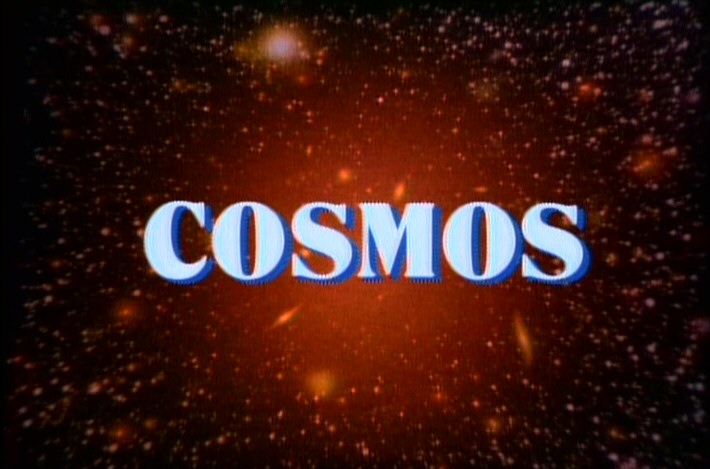
To my mind, Cosmos is one of the most beautiful and important works set to film. If I believed in mandatory media, it would certainly make the top of my list. As it is, the series has been seen by more than 500 million people in 60 countries. Alas, as of this writing MrBeast’s, ‘Squid Games in Real Life‘ YouTube video has been watched more than 877 million times (in 3 years). And whereas I’m down for an entertaining MrBeast video, they aren’t in the same solar system of enlightenment value. I can’t help but think that if more people were exposed to Cosmos the world might be less superstitious, more humane, and more forward thinking.
Alas, in spite of the cutting-edge special effects of the day much of the original Cosmos will look dated to modern audiences even though the vast majority of the science has held up and would still be eye opening to modern audiences.
But having watched the series a number of times, I’m always grateful for the refresher and I’m stirred by the musical score and Carl Sagan‘s peaceful, resonant, evocative delivery and beautiful writing (with Ann Druyan, and Steven Soter.)
The world lost Carl Sagan December 20, 1996. Among other achievements, he was the greatest science educator of our time.
In 2014 the series was continued as Cosmos: A Spacetime Odyssey and then another again in 2020 with Cosmos: Possible Worlds. Both were presented by Neil deGrasse Tyson. The sequel series are very worth watching. Both were again cowritten by Ann Druyan and Steven Soter but Sagan’s voice (both written and spoken) are missed.
I fear that we’ll never have such a broadly shared science education again in our fractured media landscape.
“We inhabit a universe where atoms are made in the centers of stars; where each second a thousand suns are born; where life is sparked by sunlight and lightning in the airs and waters of youthful planets; where the raw material for biological evolution is sometimes made by the explosion of a star halfway across the Milky Way; where a thing as beautiful as a galaxy is formed a hundred billion times – a Cosmos of quasars and quarks, snowflakes and fireflies, where there may be black holes and other universe and extraterrestrial civilizations whose radio messages are at this moment reaching the Earth. How pallid by comparison are the pretensions of superstition and pseudoscience; how important it is for us to pursue and understand science, that characteristically human endeavor. ”
~ Carl Sagan, Cosmos

Recent Comments