

I love Alfred Hitchcock’s 1960 masterpiece, Psycho. I wouldn’t even say that it ‘holds up’ to modern movies; I’d say that it exceeds most of them. And I resent spoilers enough to say, on the off chance that you’ve either not read the book or seen the movie, stop reading this post now because there are spoilers ahead.
A recent Netflix dramatization, Monster: The Ed Gein Story heavily references Psycho. I was aware of the corollaries between the fictional Norman Bates and Ed Gein before this recent series, but watching the show I was further enticed to read the source material: Robert Bloch’s 1959 novel.
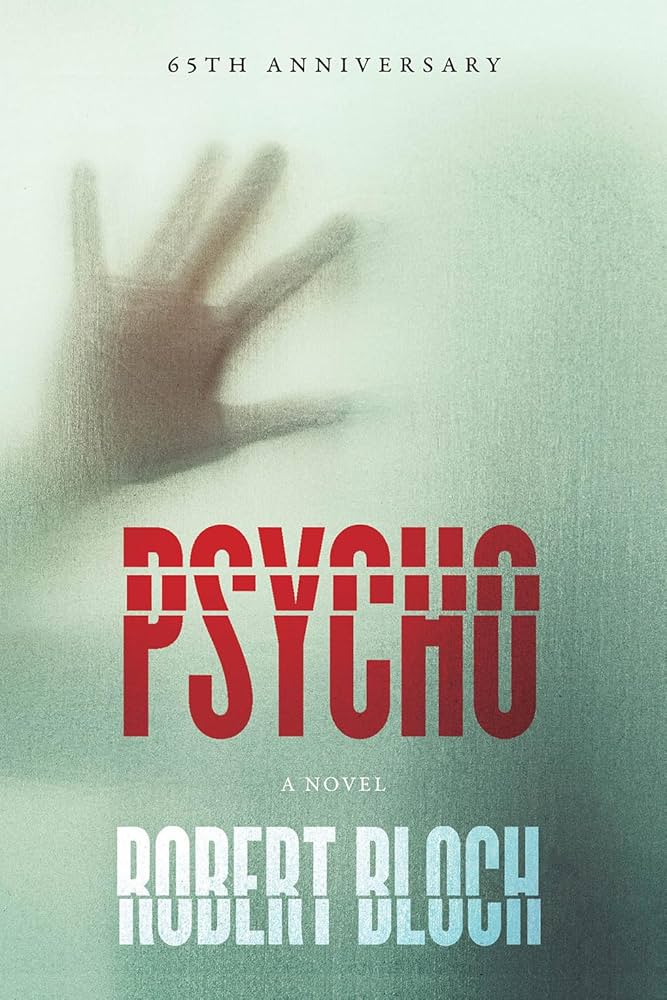
The book and the movie are remarkably close to each other. Still, I was entertained by some noteworthy differences.
State of Confusion
First off, in the book the story isn’t set in California. The movie firmly plants the motel in Shasta County, California, right off Highway 99. It gives it that sunny, desolate, West Coast vibe.
The book? It’s vaguely Midwestern. We know the town of Fairvale is a county seat, in an unspecified state.
Not Your Mother’s Norman
Book Norman wears rimless glasses, is pudgy, balding, 40 years old and prone to secretive drinking. He’s also a much less sympathetic character; his internal monologue makes up much of the text and this portrays him as misogynistic and utterly antisocial. He’s also obsessed with sociology, the occult, psychiatry, and owns some (implied dark) pornography.
Triple Threat
In the movie, Anthony Perkins plays Norman as a twitchy, tragic figure housing two personalities: himself and “Mother.” Whereas the novel delves further into the psychology, suggesting Norman is actually juggling three distinct fragments: Norma (the domineering Mother), Norman (the frightened little boy), and “Normal” (the adult version just trying to run a business and keep the other two in check).
The book is specific about the origins of Norman’s split personalities. It notes that his mother was 39 and her fiancé was 40 when Norman poisoned them with strychnine. The text explicitly suggests that after Norman poisoned them and wrote the suicide note in his Mother’s practiced handwriting, his brain fundamentally “changed” to hers at that very moment he scribed that letter.
Blackout at the Bates
For the famous shower scene the book Norman watches Marion ‘Mary’ Crane through the peephole as he does in the movie, but an intriguing difference is his drinking while he does so. The book implies that his character passes out while drinking and that is how he is unaware that ‘Mother’ has come and killed Mary in the shower.
A Clean Cut
The book’s shower scene is quick. Mary can see the face of the person who will end her life. She doesn’t recognize them though, because their features are covered with dead-white powder and two spots of rouge on the cheekbones. It’s the face of a “crazy old woman”. Bloch writes:
“Mary started to scream, and then the curtains parted further and a hand appeared, holding a butcher knife. It was the knife that, a moment later, cut off her scream.
“And her head.”
Leading Lady
As in the movie, book Norman is caught off guard by the Private Detective Arbogast. But in the book, when the sheriff shows up next Norman is better prepared and convinces the Sheriff nothing is wrong. (Going so far as to let him search his house and the motel unaccompanied since he has hidden Mother in the basement’s fruit cellar, the entry hidden by a blanket.)
And so when the victim’s sister (Lila) and fiancé (Sam) show up looking for answers, book-Norman knows precisely what they are up to. He even predicts that people like them would eventually come looking. He also immediately recognizes Lila as Mary’s sister.
Throughout the book, we follow much of the story from Sam and Lila’s perspective. Sam is always cautious, always waiting for the detective or sheriff to get back to them whereas it is Lila who is impatient with all of the waiting around. When they find Mary’s earring in the room where she stayed, Sam sends Lila off to get the sheriff while he plans to distract Norman.
This leads to a great moment in the text that highlights this difference. In the book, Sam thinks Lila has snuck off to get the sheriff. In the hotel office, he tells Norman that ‘his wife’ had to run into town to get cigarettes. However Norman actually sees Lila driving up to the house right over Sam’s oblivious shoulder and he toys with Sam, eventually confessing that his Mother is still there before knocking him unconscious with the bottle of booze that Norman convinces Sam to share with him.
The book’s Sheriff Jud Chambers plays more of a role. Between the time he first met with Sam and Lila and later Norman, he intuits that he should go back to the hotel and so he finds the unconscious Sam and it is both he and and Sam that rush to the house after they hear Lila screaming.
And speaking of screaming: that wild, over-the-top thrashing Norman and gap-mouthed expression he makes when he’s finally caught at the end of the film? – Anthony Perkins wasn’t just chewing the scenery. It almost perfectly mirrors a clinical description of “hysteria” found right there in Chapter 15 of the book.
The last shot of the movie is one of the cars being pulled from the swamp but provides no other clarity. But the book elaborates that when the stolen money is finally retrieved from the swamp, it’s described as having “not a speck of mud on it” as a point of some irony.
Ghoul Next Door
Hitchcock’s film feels like a contained, gothic nightmare. The book, however, isn’t afraid to ground itself in real-world horror. In the penultimate chapter, Bloch explicitly references the real-life Ed Gein murders, anchoring his fictional monster to a genuine historical psycho.
According to Wikipedia:
‘With Psycho being optioned for film adaptation as a direct result of media attention on Gein, Bloch later revealed he was inspired more by the circumstances surrounding Gein’s case—the idea that “the man next door may be a monster unsuspected even in the gossip-ridden microcosm of small-town life.” Years later, when the full details of Gein’s crimes were revealed, he was struck by “how closely the imaginary character I’d created resembled the real Ed Gein both in overt act and apparent motivation.”‘
Shrink Rap
If you’ve seen the movie, you remember the ending. The psychiatrist delivers a ten-minute TED Talk explaining dissociative identity disorder to the other characters (and the audience) while they sit around stupefied.
The book handles this exposition with Sam Loomis relating the psychiatrist’s findings to Lila himself. Sam is hesitant to tell Lila that Norman has been found insane and won’t stand trial. Lila is actually glad for that and feels pity for Norman who she sees as a victim himself.
Buzz Kill
Like the movie, the book ends from the perspective of Mother, who has killed off both the boy Norman and the adult “Normal” in her mind. She fancies that she either killed them or they were only a bad dream. Regardless, as in the movie, she guesses that she is being watched by the authorities and decides to sit and be quiet, resolving not to swat the fly that lands on her hand. “They’ll say, ‘Why, she wouldn’t even harm a fly.'”

Recent Comments