

Most of us spend our days feeling like a single, solid unit—a person sitting in a chair, walking to the car, or staring at a screen. But beneath the surface of that perceived stillness is a logistical feat that rivals the busiest cities on Earth. Right now, in nearly every cell of your body, trillions of microscopic “motor proteins” called kinesin are literally walking. They possess two “feet” and a distinct stride, hauling massive chemical payloads along cellular tracks to exactly where they are needed. They don’t just drift; they step, they pull, and they deliver.
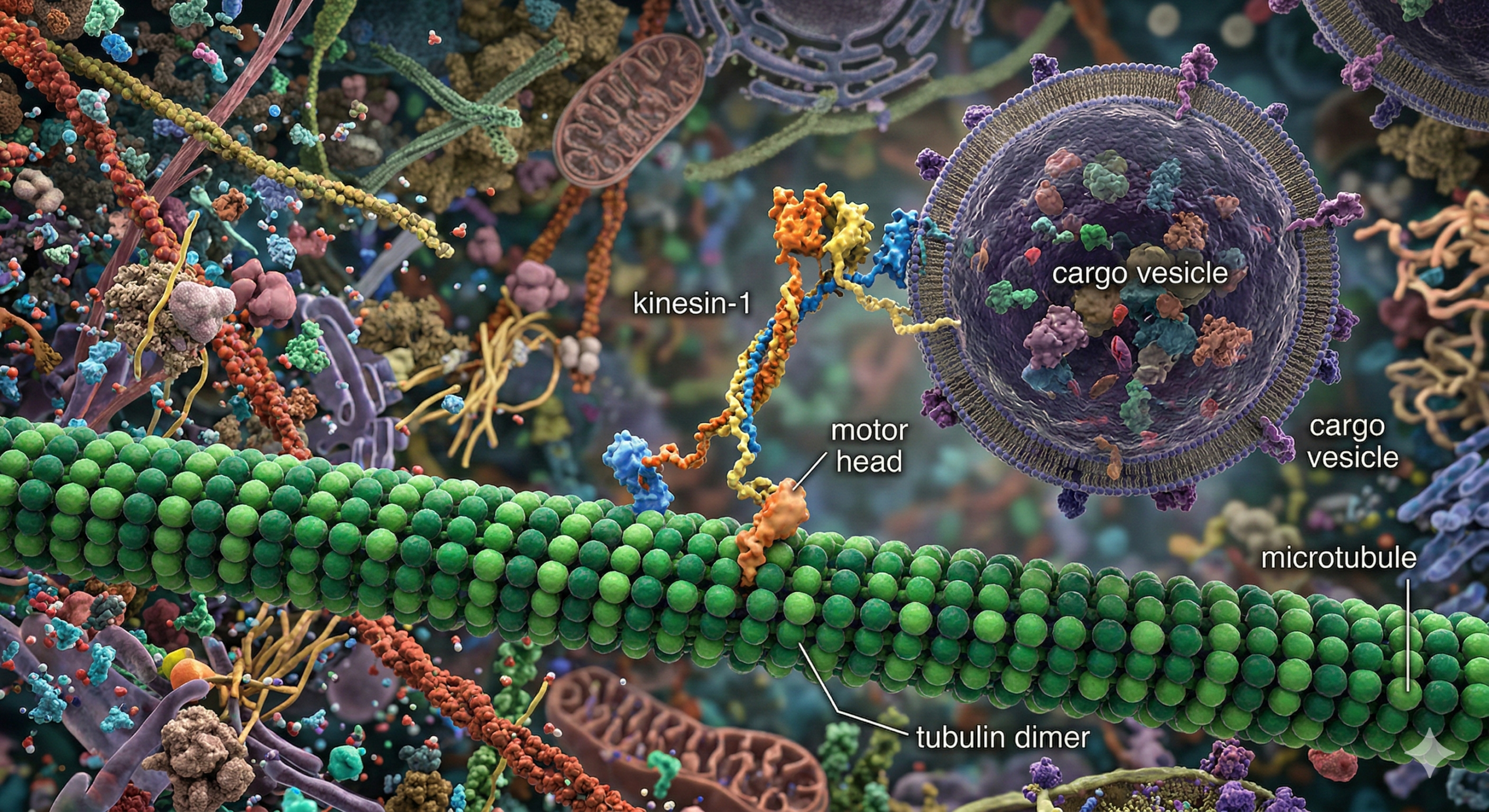
Microtubule: These are the “highways” of the cell. They are microscopic, hollow tubes made of protein that provide structural shape to the cell and act as tracks for moving materials from one place to another.
Tubulin Dimer: These are the individual building blocks of the microtubule. Each “bead” you see on the green track is a tubulin dimer. They stack together in a precise, repeating pattern to build and extend the cellular highway.
Kinesin-1: This is the specific “motor protein” or the “worker.” It is a biological machine that converts chemical energy into mechanical work, allowing it to move and carry supplies throughout the cell.
Motor Head: These are the “feet” of the kinesin. There are two of them, and they work in a hand-over-hand (or foot-over-foot) motion. When one foot binds to the microtubule, it triggers a snap-like motion that swings the second foot forward, creating a literal walking stride.
Cargo Vesicle: This is the “shipping container.” It is a fluid-filled sac enclosed by a lipid membrane that carries essential materials—like neurotransmitters, proteins, or nutrients—to their specific destination within the cell.
The sheer scale of this internal industry is staggering. While you take a single breath, billions of these tiny laborers have completed marathons of transport within you. We often look to the stars to feel small, but looking inward is equally humbling. We are not just a single consciousness; we are a vast, bustling cosmos of coordinated effort. Knowing that this tireless, mechanical power hums within us at every second is more than just a biological fact—it is a reminder that we are never truly idle, and we are far more complex than our daily perceptions allow us to believe.
The most profound aspect of these molecular walkers is that they require no supernatural explanation to inspire awe; their existence is a triumph of physics and billions of years of biological refinement. We didn’t find them through revelation, but through the relentless curiosity of cryo-electron microscopy and molecular modeling—tools that allowed us to peer into the dark and find a mechanical reality more sophisticated than anything we could have imagined. To see the kinesin “stride” is to realize that the universe doesn’t need magic to be wondrous; it only needs the elegant, unswerving laws of nature working at a scale we are finally beginning to comprehend.
“Our membranes hold against equilibrium, maintain imbalance, bank against entropy… We are shared, rented and occupied.”
~ Lewis Thomas; The Lives of a Cell.

Recent Comments