


Mengele’s Zoo and the Language of Labels
I recently watched a documentary titled “The Secret History of Auschwitz’s Seven Dwarfs“. It chronicles the Ovitzes, a family of seven Jewish dwarf entertainers who were subjected to the horrific experiments of Dr. Josef Mengele. It was heart-wrenching, as any story from that era is, but it was also a rare look into the deadly persecution faced by those who didn’t fit the Nazi ideal of physical perfection.
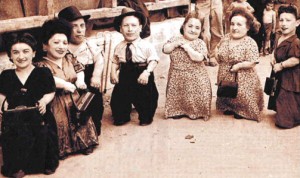
What struck me most wasn’t just the history, but the language. The narrator, Warwick Davis—an actor and a dwarf himself—referred to the condition as a “deformity” several times without batting an eye.
“People who had any kind of physical deformity, including dwarves like me, became an obsession for the Nazis.”
~ Warwick Davis
Additionally, Perla Ovitz—the youngest of the siblings and a survivor of the experiments—is famously quoted in her memoirs and interviews using the term herself:
“If I ever wondered why I was born a dwarf, my answer would have to be that my handicap, my deformity, was God’s only way to keep me alive.”
~ Perla Ovitz
In our modern world of “Little People” and “People with Dwarfism,” that word feels like a jagged rock in a stream of smooth euphemisms.
This tension between a “medical defect” and a “personal identity” is where the language gets complicated. It reminds me of the perspective held by many in the Deaf community. For those outside that world, deafness is often viewed strictly through a medical lens—a shortcoming to be “cured” or a disability to be mitigated with technology like cochlear implants.
However, many within the community don’t see themselves as “broken” versions of hearing people. They view Deafness (often capitalized to denote culture) as a complete linguistic and social identity. To them, the push for a “cure” can feel less like a kindness and more like an erasure of their culture.
We see the same friction in the dwarfism community. While some seek medical interventions to reach a “typical” height, others view their stature as a fundamental part of who they are. When Warwick Davis uses a word like “deformity,” he is acknowledging the medical reality that the Nazis obsessed over. But for a modern audience, that word feels dangerous because it suggests that the person is “deformed” rather than just “different.”
This conflict—the battle between how the world labels our bodies and how we choose to inhabit them—is the engine that drives what linguists call the Euphemism Treadmill.
Running in Place
The Euphemism Treadmill is the process where a “kind” or “clinical” word is introduced to replace a tainted one, only for that new word to eventually soak up the same stigma and become an insult itself.
Think of the word “retarded.” When I was growing up, it was the academic and professional way to refer to specific IQ ranges. But at the same time, it was a common playground insult. Eventually, the medical community moved to “Intellectual Disability” to escape the sting.
Before “retarded” became the standard clinical term in the mid-20th century, psychologists and physicians used a specific hierarchy based on the newly developed Binet-Simon IQ scale. In the early 1900s, Dr. Henry H. Goddard (a prominent American psychologist and eugenicist) popularized a classification system that was once considered cutting-edge science:
• Idiot: Historically the lowest category, referring to those with a “mental age” of under 3 years and an IQ below 25.
• Imbecile: The middle tier, referring to those with a mental age of 3 to 7 years and an IQ between 25 and 50.
• Moron: A term actually coined by Goddard himself (from the Greek mōros, meaning “foolish”). It described the “high-grade” category: those with a mental age of 8 to 12 and an IQ of 50 to 70.
At the time, these weren’t seen as insults; they were labels meant to help the state determine who needed support (or, more darkly during the eugenics era, who should be institutionalized). However, because the underlying stigma against the condition remained, the public quickly “co-opted” these clinical words as weapons, forcing the medical community to keep running on the treadmill toward “Mental Retardation.”
More recently, we have seen the term “Special Needs“ follow the same path. Introduced as a “person-first” and empowering alternative to “handicapped” or “disabled,” it was meant to highlight that an individual simply required different accommodations to thrive.
However, many disability advocates now view “special” as patronizing or infantilizing. In common parlance, it has often been used as a sarcastic slur (e.g., “What are you, special?”), demonstrating that even the most “kindly” intended euphemism can be weaponized if society isn’t ready to view the person as an equal. Recent studies have even suggested that the term “special needs” is actually perceived more negatively by the public than the word “disabled,” proving that the treadmill is still moving—perhaps faster than ever.
We see this in every facet of identity. I remember teachers in my youth using the term “Negro” alongside “Caucasian.” At the time, it felt civil—even scientific. But while “Caucasian” has stayed in a state of clinical stasis (likely because there is no social stigma for the dominant group to attach to it), “Negro” became a relic of a subservient past, replaced by “Black,” then “African American,” and now, largely back to a capitalized “Black.”
The Anxiety of the Well-Intentioned
There is an incredible scene from a 1974 episode of All in the Family (“Lionel’s Engagement“) that captures this exhaustion perfectly. When (two black characters,) young Lionel responds to his Uncle Henry using the term ‘colored’:
Lionel: “Uncle Henry, we don’t say ‘colored’ anymore. We’re Black.”
Uncle Henry: “It took me thirty years to get from ‘nigger’ to ‘colored.’ It took me another fifteen to get from ‘colored’ to ‘Negro.’ You’re just gonna have to give me a little time to get to ‘Black’.”
That scene with Uncle Henry is powerful because it shows the wear and tear the “treadmill” inflicts on the person being labeled. But there is a flip side to that exhaustion: a peculiar kind of modern social paralysis for the person doing the labeling. We’ve become so conditioned to expect the next shift in terminology that we often find ourselves stuttering over the most obvious facts.
I experienced this once at a restaurant. I needed to identify our waitress (whose name I’d either not heard or remembered) to another staff member. The team member asked who she was. Since our waitress was the only Black person working there, I said to her colleague, “She’s Black.” The coworker laughed, telling me how often people struggled to describe her using any reference but her skin color, avoiding the most obvious physical identifier/ differentiator because they were terrified of sounding shallow or racist.
This highlights the anxiety of the well-intentioned. We jump through linguistic hoops to avoid being “offensive,” sometimes at the cost of simple utility.
Construct vs. Biology
As a Humanist who values critical thinking, I have to ask: where is the line?
“Race” is a social construct, not a single biological factor, yet we cannot ignore the reality of skin color any more than we can ignore the reality of height. Warwick Davis using the word “deformity” is a nod to a medical reality—a Growth Hormone Deficiency or structural difference that is as real as gravity.
Is “Little People” a kinder term, or is it infantilizing? Is “African American” more precise, or does it ignore the vast diaspora of Black people who aren’t American or African?
“The euphemism treadmill conveys a deeper truth: that the meanings of words are not in the words themselves but in the minds of the people who use them.”
~ Steven Pinker, The Blank Slate
The Moral Effort of Language
I don’t think there is a single conclusion to be drawn, but there is a hopeful one. The existence of the treadmill is proof of consistent moral effort. The fact that we keep trying to find a “kinder” word—even if we stumble—shows that our collective conscience is active.
I recall Penn Jillette saying in his his podcast, “Penn’s Sunday School“ using a specific “cost-benefit” logical framework for calling people by the what they asked to be called:
“It costs me absolutely nothing to call you what you want to be called. It makes you feel better, it makes your life easier, and it has zero negative impact on me. Why on earth wouldn’t I do it?”
We are all born into a state of “accidental ignorance.” We might be “late to the new term” sometimes, like Uncle Henry, but as long as the intent is empathy and the impact is growth, perhaps we can forgive ourselves for the occasional misstep on the treadmill.
“Hello, babies. Welcome to Earth. It’s hot in the summer and cold in the winter. It’s round and wet and crowded. At the outside, babies, you’ve got about a hundred years here. There’s only one rule that I know of, babies: God damn it, you’ve got to be kind.”
~ Kurt Vonnegut, God Bless You, Mr. Rosewater

Recent Comments