

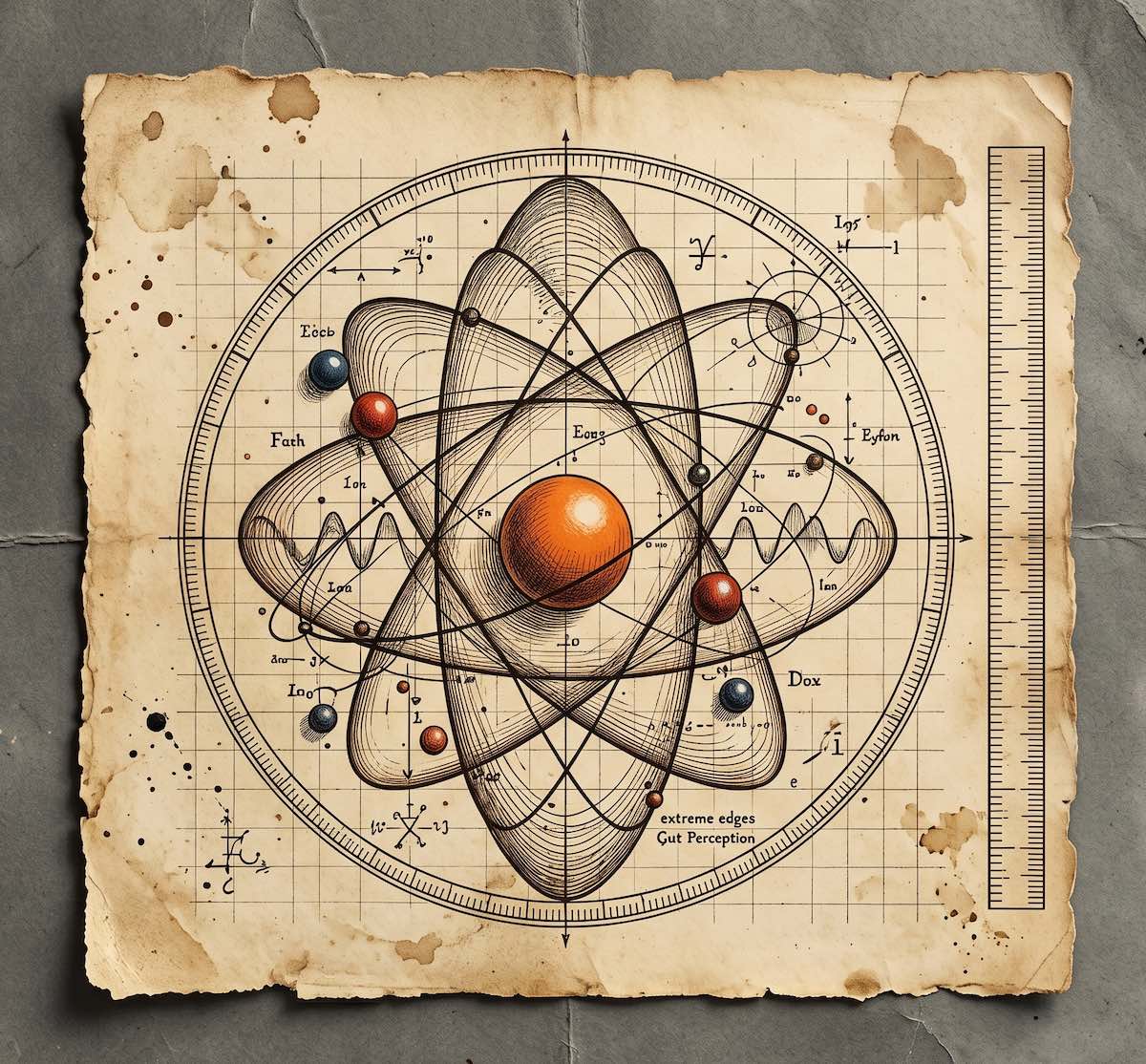
We are creatures of the middle scale. Our brains evolved to navigate a very specific slice of reality—one where rocks are reliably solid, a steady clock ticks at the same rate for everyone, and the vacuum of space is completely empty. Because our ancestors’ survival depended on mastering this macro-world, our intuition is hardwired for it. When we looked out at the vast gaps beyond our senses, we naturally projected these human-scale rules onto the cosmos, inventing myths to explain the unseen.
But at the extreme edges of the universe, our common sense turns out to be an illusion.
Zoom into that rock, and you find it is mostly empty space, held together by fields of force. Accelerate a clock near the speed of light, and time stretches and slows. Empty space itself, when viewed closely enough, boils with particles popping into and out of existence.
The universe is under no obligation to conform to our biological limits.
When we look past our narrow sensory band using the lens of science, common sense evaporates. It is replaced by a reality far more astonishing than any ancient superstition ever imagined—one where the impossible happens by the trillions every single second, right under our noses.
The Atomic Ghost
Consider the flash memory quietly humming inside your phone, your laptop, or the massive data centers routing this very text.
To a human brain, that drive is a inert block of plastic and metal. But step down into the subatomic landscape, and the rules change entirely. Inside the drive’s memory cells lie microscopic walls of insulating oxide, less than ten nanometers thick. According to the classical laws of physics—the physics of our everyday scale—an electron hitting that barrier should stop dead, like a tennis ball bouncing off a concrete wall. The energy required to leap over it is simply too high.
But an electron does not play by human rules.
At this scale, a particle behaves like a wave of probabilities. It does not exist in one definitive point; it ripples. When an electron encounters that insulating wall, its probability wave bleeds right through to the other side. There is a tiny, mathematically precise chance that the electron will simply exist on the far side of the barrier.
But in quantum mechanics, the electron never actually “travels” through space from point A to point B in the way a tennis ball does. Because it is a wave of probability, it already occupies both sides of the barrier simultaneously before it is observed.
When it encounters the thin insulating oxide wall, its wave function doesn’t stop sharply; it decays exponentially insidethe wall, but if the wall is thin enough, the wave hasn’t dropped to zero by the time it reaches the other side. When the flash memory chip reads the cell, the wave function collapses, and there is a definitive chance the electron manifests on the far side. It didn’t travel through a wormhole or dematerialize; it was simply allowed to exist there because its wavy nature extended past the barrier.
This is quantum tunneling. It is not magic, nor is it a breakdown of reality where nothing is knowable. It is a fundamental law of nature, described with exquisite mathematical precision. We have understood it so thoroughly that we have industrialized it. We mass-produce microscopic architecture specifically designed to exploit this subatomic whim, forcing trillions of electrons to break through physical walls daily just to save a line of text or a family photo.
Why the Sun Shines
If you look up at the daytime sky, you are witnessing the same subatomic physics operating on a celestial scale. The core of the Sun is a crushing furnace under immense gravitational pressure, heated to fifteen million degrees Celsius. Yet, remarkably, it is not hot enough.
The hydrogen ions—isolated protons—inside the core all carry positive charges, causing them to violently repel one another. To fuse and ignite the star, these protons must overcome this electrostatic repulsion, a massive energy wall known as the Coulomb barrier. By all the rules of classical mechanics, the protons simply lack the kinetic energy to breach it; they should bounce off one another like matching poles of powerful magnets. By our ordinary intuition, the protons should never touch. The Sun shouldn’t shine.
But at these extreme densities, the wave functions of these rushing protons overlap. Through the proton-proton chain reaction, quantum tunneling takes over. Even though a single proton hits the Coulomb barrier with insufficient energy, its probability wave occasionally bleeds through to the other side.
The mathematical odds for any individual proton to tunnel through are astonishingly low—roughly one in a hundred million billion. But the Sun’s core contains such an unfathomable quantity of hydrogen that these impossible odds turn into a statistical certainty. Trillions of times every second, protons slip through their mutual energy barriers, allowing the strong nuclear force to take over, fusing them into helium and releasing the torrent of light and warmth that permits our existence.
Displacing the Supernatural
Science does not merely expand our view; it actively displaces the supernatural. The ancient myths weren’t early approximations of truth—they were fundamental misunderstandings born of our sensory limits. We now know that the universe requires no divine intervention to function, nor does it harbor magical exceptions to its rules. Instead, it operates on cold, unyielding physical laws that span from the subatomic to the cosmic.
“The story of human history is a story of the gradual realization that we are not at the center of the universe, that the universe was not made for us, and that we are governed by laws that are completely indifferent to us. And yet, that realization doesn’t diminish our significance; it enhances it.”
~ Brian Cox, Human Universe (2014)
It is a profound realization: the mechanism of quantum tunneling that powers the silicon memory chips in our devices is the very process that forces hydrogen atoms to fuse inside the core of the Sun.
This seamless continuity across scales reveals a universe that requires no mystical architecture to be awe-inspiring. It is an entirely natural, interconnected reality where the same fundamental mechanics govern both the immense and the infinitesimal. The universe as it actually exists—unveiled by the rigorous light of science—demonstrates that nature alone is sufficient and possesses the mechanics necessary to ignite the stars and, simultaneously quietly anchor our digital lives by guiding an electron through a silicon wall quadrillions of times a second.
Nature Alone is Sufficient
When we abandon our provincial, human-scale narratives, we don’t surrender our sense of wonder: we finally unlock it. Our gut perceptions were built to navigate the immediate and the obvious, but the cosmos refuses to be bound by the limits of our biological common sense. The physical truth itself, running seamlessly from the invisible gymnastics of electrons to the brilliant ignition of the stars, is already a masterpiece of natural poetry. It is a reality far grander, more elegant, and more breathtaking than any myth we ever engineered to fit our narrow perspective.
“For far more marvelous is the truth than any artists of the past imagined! Why do the poets of the present not speak of it? What men are poets who can speak of Jupiter if he were like a man, but if he is an immense spinning sphere of methane and ammonia must be silent?”
~ Richard P. Feynman, The Lectures on Physics (1963)

Recent Comments