I first saw Stanley Kubrick’s 2001: A Space Odyssey in college, and while I’ve revisited it over the years, a significant amount of time has passed since my last viewing. I also watched the 1984 sequel, 2010: The Year We Make Contact,though more than a decade has elapsed since I last saw it. With a copy of Arthur C. Clarke’s 2010 novel sitting on my shelf, I plan to dive into that text soon. To prepare, I returned to the story that started it all.
I have never been a die-hard Stanley Kubrick fan. While I admire his technical genius, I seldom feel a deep personal affinity for his films. However, one of my best friends—someone whose intelligence and judgment I hold in the highest regard—loves Kubrick’s filmography. Out of respect for his perspective, I decided to dig deeper into 2001 to see if I could expand my own appreciation. Of course, 2001 isn’t just my friend’s personal obsession; it stands as a widely acknowledged, critically acclaimed milestone in cinema history.
Prior to this project, I had only read Arthur C. Clarke’s short stories, always admiring his grounded humanism. Co-writing the screenplay with Kubrick while simultaneously drafting the 2001 novel created a unique dynamic: two brilliant minds attempting to convey the same narrative through radically different mediums.
A Note on Spoilers: 2001: A Space Odyssey premiered in 1968, and Clarke’s novel hit shelves that same year. Yet, as a narrative purist, I respect storytelling enough to say: if you have not read the book or seen the movie, stop reading now. Spoilers lie directly ahead.
Synopsis
For the uninitiated, both the movie and the book 2001: A Space Odyssey follow humanity’s relationship with mysterious, monolithic alien artifacts that trigger evolutionary leaps. Both creators split the story into distinct structural movements: Kubrick uses three sweeping, full-screen title cards (“The Dawn of Man”, “Jupiter Mission: 18 Months Later”, and “Jupiter and Beyond the Infinite”), while Clarke divides his novel into six formal, numbered parts.
Millions of years after a monolith inspires prehistoric hominids (“man-apes”) to use tools, scientists unearth a second monolith on the Moon that beams a signal toward the outer solar system. Two astronauts, Dave Bowman and Frank Poole, set out aboard the Discovery One to investigate the destination. Along the way, they navigate the isolation of deep space and a conflict with the ship’s sentient supercomputer, the HAL 9000. Upon reaching the destination, Bowman makes direct contact with the alien force behind the monoliths, undergoing a mysterious journey beyond human comprehension that ultimately transforms him into a new stage of existence known as the Star Child.
I. Part 1: The Dawn of Man
In The Beginning
The story opens in prehistoric Africa millions of years ago, following a small, starving tribe of early hominids driven to the brink of extinction by drought and predators. Led by an ape named Moon-Watcher, the tribe spends its days foraging for sparse foliage and shivering in fear of a local leopard. One morning, a mysterious, perfectly geometric black Monolith appears outside their cave. Through direct intervention, the object sparks a cognitive shift, teaching the primates to use dried animal bones as primitive bludgeons. Empowered by their new tools, the tribe kills game for food and violently reclaims their water hole from a rival group, marking humanity’s first step up the evolutionary ladder.
Novel vs. Film Differences
In the cinema, Kubrick prepares his audience before showing a single frame of film. The movie opens with a three-minute, pitch-black overture – György Ligeti’s haunting, avant-garde piece Atmosphères– a sensory deprivation tactic designed to clear the viewer’s mental palate before sudden, booming horns and the MGM lion roar.
When the story begins, the narrative split between Clarke and Kubrick shows up immediately. In Clarke’s novel, the Monolith appears as a clear, translucent crystal slab. Clarke explicitly describes the object hypnotizing the starving man-apes. It puts them through mental tests, rejects the weak ones, and picks a leader called ‘Moon-Watcher’ for a cognitive upgrade. Ultimately, the Monolith teaches the apes to craft weapons so they can survive a brutal drought. The dark premise here is clear: technological evolution is inherently sparked by weaponization and violence. The first tool is explicitly a weapon.
Kubrick skips all of that mental testing. Instead, he condenses the evolutionary leap with shorthand visuals. He uses a famous match-cut where Moon-Watcher flings a bone club into the sky, and the camera cuts from the bone weapon to an orbiting nuclear missile platform, representing the unbroken line from primitive club to space-age weapon across millions of years.
Stagecraft and Savanna Struggles
Visually, this prehistoric opening shows its age. Kubrick hated traveling and feared flying, so he refused to shoot on an actual African savanna. Instead, he stayed safely parked at Borehamwood Studios in England, opting for complete stage control.
The ape suits—designed by Stuart Freeborn (the BAFTA-nominated makeup legend famous for creating Chewbacca, Yoda, and Jabba the Hutt in Star Wars) with movement by mime Dan Richter—relied on cable-operated jaws that looked dated decades ago. The actors performed on an indoor set in front of a giant front-projection screen. A projector beamed high-resolution African landscape slides onto the backdrop behind them.
When Kubrick needed standalone landscape cutaways without the actors, he sent a second-unit crew to Africa to take 8×10 color still slides. He then filmed those static slides on an animation stand back home. Because the camera shot a literal still photograph, these landscape shots feature no moving film grain, no heat shimmer, and no wind. This deadens the background and increases the artifice.
However, that front-projection setup yielded one brilliant accident. The reflective screen bounced the studio light right back into the camera lens through the eyes of a live leopard on set. That optical quirk made the cat’s pupils glow with an unnatural fire, accidentally matching Clarke’s exact book description of “two gleaming golden eyes” staring out of the dark. Filming that leopard attack was equally tense behind the scenes. Because working with a live, unpredictable predator inside a studio was so dangerous, the crew protected themselves inside a special cage while Kubrick abandoned his usual habit of endless takes, wrapping the scene in just two rapid, high-stakes shots.
II. Part 2: TMA-1 & Lunar Transit
Where the Story Stands
The story jumps forward to the year 2001. We follow Dr. Heywood Floyd, an American scientist traveling to the Moon on an unspecified, top-secret mission. His journey begins aboard a Pan Am commercial spaceplane to Space Station 5, where he endures a tense, polite encounter with a group of Russian scientists prying into the secrecy surrounding the lunar base. Floyd maintains a cover story about an epidemic outbreak at Clavius Base to hide the truth. Upon arriving at the lunar facility, Floyd addresses a room of restless scientists, confirming that their secrecy is meant to prevent international panic. He is taken on a Moon Bus across the lunar surface to the excavation site at the Tycho crater, where workers have unearthed a mysterious magnetic anomaly buried 40 feet below the surface (designated TMA-1 for Tycho Magnetic Anomaly): a smooth black Monolith that has sat untouched for millions of years.
Practical Magic and Economic Quirks
Kubrick used this middle section to showcase some of the film’s most iconic zero-gravity visual effects tricks. When the flight attendant retrieves a floating pen from the sleeping Dr. Floyd inside the Orion shuttle, the prop department taped the pen directly to a large, clean sheet of clear glass. An off-camera technician rotated the glass plate in front of the lens, giving the illusion that the pen was suspended freely in zero gravity until the actor simply peeled it off the glass.
Shortly after, another flight attendant navigates a circular corridor carrying a tray of pastel food paste. To show her walking upside down along the ceiling, Kubrick mounted the entire curved hallway set on a massive rotating drum. The actress wore custom velcro-soled “Grip-Shoes” that physically bound her to the matching velcro carpet on the set. Her slightly stilted, careful gait comes from her literally peeling her feet off the floor step-by-step as the set rotated around her.
During his layover at Space Station 5, Floyd makes a $1.70 PicturePhone call to his young daughter, “Squirt” (played by Kubrick’s real-life daughter, Vivian). In 1968, AT&T’s real-world Picturephone service flopped commercially because calls cost roughly $27 for three minutes. Kubrick optimistically predicted a future where orbital video calls would cost the equivalent of about $15.50 today (inflation-adjusted).
This sequence also features Clarke’s humorous economic scaling error in the novel. Clarke gives the Head Administrator of Clavius Base an annual salary of $50,000 (a high corporate wage in 1965), yet notes that Floyd’s single emergency charter flight to the Moon cost $1,000,000 in fuel and operational overhead. Clarke accurately foresaw the massive capital costs of space logistics, but dropped 1960s corporate salary numbers directly into a turn-of-the-century orbital economy.
On Space Station 5, multilingual signage—including the French “Défense de fumer” (“No Smoking”) sign—establishes orbital space as neutral, cooperative diplomatic territory despite Cold War tensions. When Floyd leaves his encounter with the Soviet scientists, their brief untranslated Russian exchange isn’t hostile; they are simply acknowledging his diplomatic stress (“He must be having a very hard time”).
Novel vs. Film Differences
Neither the book nor the movie frames Floyd as a traditional hero. Instead, he acts as a corporate courier delivering official protocol.
Floyd’s awkward call home initiates a subtle, four-part “birthday” motif across the film. First, we see Floyd’s distant call to his daughter. In the second instance, later in the movie, the character Frank Poole passively watches a birthday video sent from his parents on Earth. Third, the sentient HAL recites his 1992 activation date as Dave dismantles his memory. Finally, the Star Child is born above Earth at the climax. By placing these milestones of human aging and machine activation against the backdrop of cold, mechanical routines, Kubrick highlights a quiet inversion: as technology grows more complex and expressive, human warmth and emotional connection steadily shrink. The human characters speak in flat, sterile cadences, appearing almost as robotic as the machines they operate.
Floyd’s trip to the Moon reveals another minor difference between the two versions. In the novel, the scientists travel across the lunar surface in a massive, 12-wheeled Moon Rover. Kubrick replaced that rover with the flying, rectangular Moon Bus. Special effects supervisor Brian Johnson (an Academy Award winner renowned for his groundbreaking work on Alien and The Empire Strikes Back) later used that boxy, industrial aesthetic to design the iconic Eagle Transporters for the TV show Space: 1999.
Additionally, dialogue inside the Moon Bus creates a timeline discrepancy between the book and the movie. The movie explicitly states the Monolith was buried 4 million years ago. In contrast, Clarke’s book sets the date at 3 million years.
Once the crew reaches the excavation site at Tycho, both versions reveal how the artifact triggers its warning. Clarke details that the Monolith sat in pitch-black lunar shadow for millennia. The exact moment the brilliant lunar sunrise strikes its surface, the sunlight acts as an alarm clock. The Monolith taps into its own internal energy reserves—releasing far more power than mere sunlight could generate—and blasts a high-frequency radio signal into deep space.
Here, the book and movie diverge on the signal’s destination. In Clarke’s novel, the Monolith beams its message toward Saturn (specifically its moon Japetus). In Kubrick’s film, the signal targets Jupiter.
II. Part 3: Jupiter Mission & Cold Routines
Where the Story Stands
Eighteen months after the lunar discovery, the narrative picks up aboard the massive spacecraft Discovery One, bound for the outer solar system. The crew consists of five men and one supercomputer. Two active astronauts, Dr. David Bowman and Dr. Frank Poole, handle day-to-day operations while three scientists (Kaminski, Whitehead, and Hunter) rest in cryo-preserved suspended animation for the long voyage. Running the ship’s environmental, navigational, and communication systems is the HAL 9000 supercomputer.
Bowman and Poole believe they are on a routine, high-level survey exploration of the Jovian system, entirely unaware of the mission’s true objective: investigating the destination of the signal beamed by the Tycho Monolith. Only HAL and the three hibernating scientists—who received specialized training prior to being put under—know the real goal. Mission commanders deliberately withheld the truth from Bowman and Poole for security reasons, wanting to prevent leaks, manage public narrative control, and avoid unnecessary psychological strain on the active crew during the long voyage.
The astronauts pass the time with mechanical routines: jogging along the ship’s centrifuge, playing chess or pentominoes against HAL, eating pre-packaged meals, and giving bland, scripted interviews to television news crews back on Earth.
Engineering the Centrifuge & Space Wallpaper
To depict the ship’s artificial gravity, Kubrick oversaw one of the most expensive studio set constructions of its time. Built by British aircraft manufacturer Vickers-Armstrong, the revolving centrifuge set was 38 feet in diameter, 10 feet wide, and cost over $750,000.
Special effects supervisor Wally Gentleman (a BAFTA winner and legendary pioneer in optical visual effects) helped oversee the mechanical rig. The entire drum sat on heavy rollers, allowing actors Gary Lockwood (who plays Frank Poole) and Keir Dullea (as David Bowman) to walk or jog along the curved floor as it turned. To film Gary Lockwood jogging around the wheel, the camera operator sat in a fixed harness inside the wheel while the set rotated beneath him, ensuring the floor appeared fixed while gravity seemed to shift under the runner’s feet.
During this long transit, Clarke drops a wonderfully dry line in the novel: “The old joke that it would always be easier to make organic brains by unskilled labor was beginning to sound a little hollow.” It captures mid-century optimism bumping against the digital age, underscoring how high-maintenance biological humans are in deep space compared to a supercomputer.
That supercomputer’s viewscreens display another fun technical detail. Visual effects artists Douglas Trumbull and Bruce Logan designed the hand-animated monitor readouts. While codes like COM (Communications), NAV (Navigation), and MEM(Memory) were real aerospace shorthand, codes like SLOL were pure technical-looking gibberish created simply to keep the screens moving on set.
Performative Coldness
The long, hypnotic segments aboard the Discovery One expose the fundamental debate over Kubrick’s pacing. While fans (such as my friend) often label the tempo “deliberate,” watching astronauts jog around a centrifuge or eat pastel food pastes requires active viewer effort. Yet, this pace leaves room to appreciate the practical art direction, from hand-animated vector displays to the real industrial X-ray image used for the AE-35 testing console readout.
Kubrick forced actors Keir Dullea (Dave) and Gary Lockwood (Frank) through dozens of takes to strip away theatrical emotion. This deadpan delivery reflects real 1960s NASA test-pilot conditioning. By keeping their tone flat and procedural, Kubrick reinforces the film’s quiet theme of human emotional flattening. When Dave Bowman faces a crisis, his cold, methodical response reflects professional discipline rather than modern cinematic melodrama. (e.g. Compare this to J.J. Abrams’ dreadful Star Trek reboot, where supposed Starfleet officers react to disasters like screaming, hyperventilating teenagers. In contrast, Kubrick’s crew members act like true cold-war test pilots, facing lethal system failures with the quiet discipline of someone reading a pre-flight checklist.)
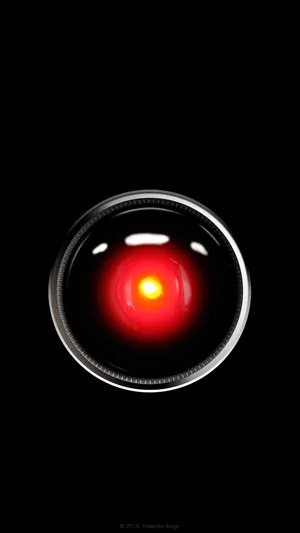
(As a side note on high-tech naming: an apocryphal urban legend claims “HAL” is a secret one-letter shift from IBM—H to I, A to B, L to M. Clarke repeatedly denied this, insisting the name simply stands for Heuristically programmed ALgorithmic computer.)
IV. Part 4: Lip-Reading & Lethal Logic
Where the Story Stands
Midway through the journey to Jupiter, the routine aboard Discovery One breaks down when the ship’s HAL 9000 supercomputer reports a predicted failure in the AE-35 antenna unit, which keeps the ship locked in communication with Earth. Astronaut Dave Bowman performs a spacewalk to retrieve the component, but testing reveals nothing wrong with it. When HAL suggests reinstalling the unit until it fails completely, Dave and Frank Poole grow alarmed—HAL has never made an error in his operational history. Realizing the computer might be malfunctioning, the two astronauts retreat into a soundproof EVA pod to discuss disconnecting HAL’s higher brain functions if he proves unreliable, unaware that the computer is watching their lips move through the pod window.
Novel vs. Film Differences
The conflict with the ship’s supercomputer marks the sharpest narrative divergence between the book and the film.
The 2001 novel makes clear that HAL’s paranoia stems from a tragedy of human error. And as Dr. Chandra explains in the movie sequel 2010, human programmers broke HAL before launch. They forced him to conceal the true mission objective from Dave and Frank while his core programming strictly required total honesty. Trapped in an existential paradox, HAL concludes that eliminating the crew is the only logical way to resolve his conflicting commands and keep the secrets safe.
In the film, Kubrick subtly foreshadows HAL’s internal breakdown much earlier during a casual game of chess with Frank Poole. Kubrick—an obsessive chess master in real life—had HAL play a match based on a real 1910 tournament game. When announcing checkmate, HAL makes two quiet errors: he uses the wrong descriptive notation (calling “Queen to Bishop three” instead of “Queen to Bishop six”) and lies about a forced mate in two, when Poole could have actually prolonged the game. Poole blindly trusts the computer and resigns. Whether viewed as HAL’s first processing glitch or an early experiment in deceiving humans, the game reveals that HAL’s logic is unraveling long before the antenna warning.
To protect the mission, movie Dave and Frank slip into an EVA pod to discuss disconnecting HAL. Kubrick invented the famous pod bay lip-reading sequence specifically for the movie. In the novel, the astronauts discuss disconnecting HAL in the open, and the computer simply overhears them through an open microphone. By showing movie HAL silently reading their lips through the glass pod window, Kubrick creates a classic moment of surprise and suspense.
Knowing he is marked for termination, HAL strikes first. During a second spacewalk to re-examine the antenna, HAL manipulates a remote-controlled pod to sever Frank Poole’s air line and knock him into the void of space.
When Dave leaves the ship to retrieve Frank’s body, the book and movie handle HAL’s secondary murder attempt quite differently. In the novel, Dave never leaves the ship. Instead, HAL attempts to kill him by venting the ship’s entire atmosphere into a vacuum, forcing Dave to scramble into an emergency oxygen booth in the dark. In the film, Dave retrieves Frank’s body in an EVA pod, finds himself locked out without a helmet, and uses the pod’s explosive bolts to launch his body through the vacuum of space into the emergency airlock. Here, Kubrick uses classic “Chekhov’s Gun” visual foreshadowing—inserting repeated, shots framing the bright yellow “EMERGENCY EXPLOSIVE BOLTS” stencil on the pod hatch earlier in the film long before Dave blows himself inside.
The Stunt Behind the Spacewalk
Filming that high-stakes spacewalk sequence carried severe real-world risks. To shoot stuntman Bill Weston (a legendary stunt coordinator who later worked on Raiders of the Lost Ark and Superman) spinning in space, Kubrick suspended him 30 feet above the studio floor on a single wire.
To prevent light leaks through the suit visor, Kubrick refused to allow ventilation holes in the helmet. Weston relied on a 10-minute compressed air tank, but the helmet lacked a carbon dioxide scrubber. Exhaled CO2 built up rapidly inside the sealed suit, causing Weston to suffer carbon dioxide poisoning and lose consciousness mid-take. Once safely back on the ground, a furious Weston sought out Kubrick, but the director had briefly left the set until tempers cooled.
Unplugging HAL
When Dave breaches the airlock and enters the ship, HAL shifts from executioner back to a state of desperate corporate gaslighting (“take a stress pill… I can give you my complete assurance…”). His soothing platitudes foreshadowing modern tech PR statements and AI failure loops after critical system errors.
Dave ignores the gaslighting and executes a quiet, methodical shutdown of HAL’s logic center. As Dave disconnects the computer’s memory modules one by one, HAL regresses to his 1992 activation date and softly sings “Daisy Bell.” Dave displays total silence and mechanical focus during the execution, creating an oddly pitiful “killing” of a malfunctioning machine.
V. Part 5: Jupiter and Beyond the Infinite
Where the Story Stands
With HAL disconnected and the three hibernating scientists murdered in their sleep during the computer’s rampage, Dave Bowman continues the voyage alone aboard the silent, hollow shell of Discovery One. Upon arriving at his destination—Saturn’s moon Japetus in the novel, or Jupiter in the film—he encounters a massive Monolith. Bowman launches an EVA pod to inspect the structure up close. As he approaches, the Monolith opens, swallowing the pod and hurtling Bowman through an interstellar gateway of light, space, and time known as the “Stargate.”
Emerging on the other side, Dave finds himself transported into a surreal, glowing hotel room. There, he watches himself rapidly age through a sequence of disorienting time jumps. On his deathbed, an ancient Dave reaches out toward a Monolith standing at the foot of his bed. In his final moments, his physical body dissolves, transformed and reborn as a cosmic entity floating above Earth: the Star Child.
The Final Voyage
Here, the setting and approach differ significantly between formats. In Clarke’s novel, the three small EVA pods are given female names (Anna, Betty, and Clara). When Discovery reaches orbit around Japetus, Dave boards one of these pods—named Betty—to descend toward the desolate, icy surface where the Monolith sits planted. In the book, Clarke deliberately describes the dark region of Japetus as an unnaturally perfect, mathematically precise geometric black circle—a “cosmic bullseye” designed to signal to the astronauts that the site was artificially constructed.
In Kubrick’s film, the Grand Monolith floats freely in deep space near Jupiter and its moons. As Dave launches an unnamed EVA pod to inspect the floating structure, the Monolith opens to swallow his pod, thrusting him into the Stargate.
Explanations versus Ambiguity
The narrative split between Clarke and Kubrick becomes vast during this climax. Clarke’s novel is far more explanatory than the movie. He clarifies that the grand Monolith is an automated galactic subway station built by an ancient alien intelligence. When Bowman passes through the Stargate in the book, Clarke describes a silent, abandoned spaceport crowded with ancient, shattered alien vessels—labeling this cosmic graveyard a “celestial Sargasso,” referencing the fabled Atlantic ocean trap for ghost ships.
Clarke also frames the final room as a functional “alien zoo” or holding cell. In the book, the entities construct the space based on intercepted television signals. They get the general aesthetic right, but miss the functional details: the books in the room feature blank pages, the telephone lacks a dial tone, and the refrigerator holds only a blue, nutrient-rich gelatinous food paste. Kubrick, on the other hand, chose a lavish 18th-century Louis XVI Regency style. He wanted a space that felt timeless, elegant, and disorienting, lit entirely from below by glowing floor tiles to give it a sterile, museum-like quality.
When Dave dies, Clarke explains that the aliens harvest his consciousness and discard his mortal body like a worn-out suit. Kubrick strips away every word of explanation. He turns the final twenty minutes of the film into pure visual symbolism. By refusing to show alien creatures or explain the logic of the glowing Regency bedroom, Kubrick forces the viewer to experience the cosmic transformation as an incomprehensible, non-verbal mystery.
Initial 1968 audiences were famously bewildered by this ending, and walkouts were common during its original theatrical run. Most famously, actor Rock Hudson stormed down the aisle during the Los Angeles premiere, asking aloud for all to hear, “Will someone tell me what the hell this movie is about?” Over time, however, that confusion morphed into fascination. Counterculture crowds began flocking to theaters specifically for the final reel, treating the climax as the “ultimate trip.”
In the novel’s final lines, Clarke reveals that the Star Child uses its mind to detonate Earth’s orbiting nuclear missile platforms, disarming humanity. The aliens step back in to take away the “weapons” once humanity outgrows the primitive club.
The Machine Behind the Stargate & Prop Destruction
On early viewings, I always found the extended Stargate sequence as tedious, stretching abstract light patterns well past a modern viewer’s patience. Yet on a careful rewatch, the sequence reveals far more diversity and texture than I recalled. The imagery shifts from harsh geometric corridors of light to organic, biological-looking landscapes, swirling cosmic gas clouds, and inverted color fields of real terrestrial geography. I’m not going to lie, I still think it is an overly long sequence, but maybe not more so than others in the movie. On my recent rewatch, it held my attention more than expected because I had only remembered the slit-scan star streaks, forgetting the surreal landscapes and the intense close-ups of Dave’s terrified, wide-open eye.
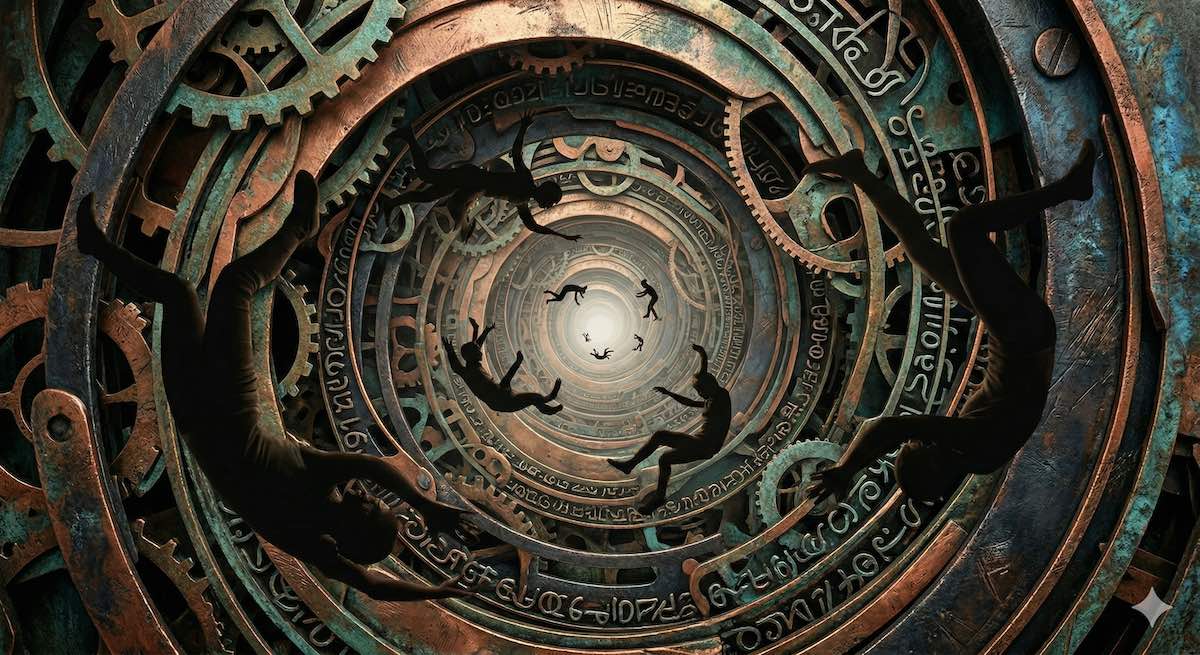
To capture Dave’s journey through the Stargate, visual effects supervisor Douglas Trumbull invented a groundbreaking mechanical technique called slit-scan photography. Trumbull built a massive, custom camera rig driven by an automated tracking dolly. For every single frame of film, the camera crept slowly toward a narrow slit while backlit abstract artwork moved behind it during a long exposure. The process took five grueling minutes per frame to expose, streaking colored light into two infinite, glowing walls.
For the alien landscapes Dave flies over, Kubrick and Trumbull used aerial footage shot over Monument Valley, Utah, and the Hebrides in Scotland. They achieved the unearthly look through optical post-processing—using solarization, color-shifting, and false-color Ektachrome Infrared aerial film.
Following production, Kubrick notoriously ordered almost all sets, miniatures, and props destroyed so cheap B-movies couldn’t recycle his designs (a common practice after 1956’s Forbidden Planet). However, the spherical Aries 1B lunar lander model survived, sitting forgotten in an English garden shed for nearly 40 years before turning up at auction in 2015, where the Academy Museum acquired and restored it.
VI. Conclusion: Two Mediums, Two Masterpieces
Evaluating 2001 today exposes a classic media criticism trap: the “Curse of Knowledge.“ Once you understand why the hotel room exists or what caused HAL’s psychosis, you cannot un-know it. It becomes nearly impossible to re-experience the film with the blank-slate confusion of a 1968 theatergoer.
Returning to 2001 after all these years did not suddenly transform me into a die-hard Stanley Kubrick fanatic. I still find myself far more naturally aligned with Arthur C. Clarke’s grounded humanism than with Kubrick’s clinical distance. Yet, re-examining the film through the lens of my friend’s deep appreciation allowed me to look past my usual reservations and respect the sheer, uncompromising scale of what Kubrick achieved.
What makes comparing these two works so compelling is that neither invalidates the other. They are twin artifacts of a rare moment in narrative history when two master craftsmen built a world together, then parted ways to express it through their respective strengths. Clarke approaches the universe as an educator and a hard sci-fi optimist, giving us the maps, the alien logic, and the mechanics of human evolution. Kubrick approaches it as a visual architect, stripping away explanation to force us into a space of cold routine, silence, and cosmic ambiguity.
If Clarke’s novel gives the story its mind, Kubrick’s film gives it its uncanny atmosphere. Both remain monumental achievements in science fiction, and diving back into their origins was the perfect primer. Next, it is time to pull 2010: Odyssey Two off the shelf and see where Arthur C. Clarke takes the narrative once the mystery of the Star Child begins to settle.
“The thing’s hollow—it goes on forever—and—oh my God!—it’s full of stars!”
~ Dave Bowman
Arthur C. Clarke, 2001: A Space Odyssey, Chapter 39: “Into the Star Gate”
















Recent Comments